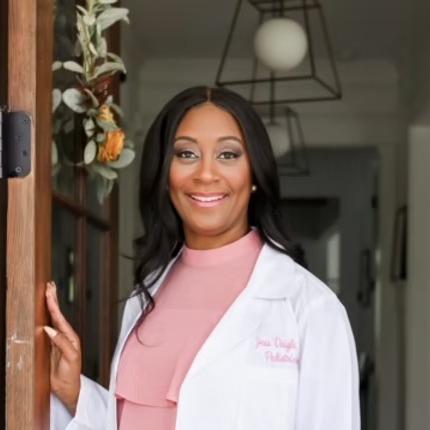
Jessica DaigleMD, FAAP
Board-Certified Pediatrician & NICU Hospitalist, Mom & Me MD
From NICU to Home: A Pediatrician’s Journey as Both Doctor and Mom
Jessica Daigle, MD, FAAP, a board-certified pediatrician, NICU hospitalist, and founder of Mom & Me MD, on what her own NICU stay taught her, the emotional weight parents carry home after discharge, and why discharge isn’t the end of the NICU story.
Dr. Jessica Daigle understands the NICU from both sides. As a board-certified pediatrician and pediatric hospitalist, she’s spent her career caring for newborns in the highest-stakes moments of their lives. But long before she was the one delivering updates to anxious parents, she was one herself — twice over, with both of her children born premature and her first admitted straight to the NICU.
That dual perspective is the foundation of Mom & Me MD, the practice she founded to help families not just survive the fourth trimester, but truly thrive in it. In this conversation, Dr. Daigle opens up about what her own NICU stays taught her that residency never could, the misconceptions she sees new parents wrestling with every day, and the one piece of advice she wants every family to carry home with them.
What inspired you to create Mom & Me MD, and how did your own experience as a NICU mom shape your approach to caring for families?
Jessica DaigleMom & Me MD really grew out of the intersection of my personal and professional lives. I’m a pediatrician, but I’m also a mom who has experienced pregnancy loss, a complicated pregnancy, bedrest, preterm birth, the NICU, and then bringing a medically complex baby home.
My son Liam was born at 31 weeks and spent five weeks in the NICU. Even with my medical training, I learned very quickly that knowing medicine and living through the experience as a parent are two very different things. There were fears, questions, emotions, and transitions that medical knowledge alone could not prepare me for.
That experience fundamentally changed the way I care for families. I began to recognize that families often need more than medical information. They need someone to help them understand what is happening, anticipate what may come next, ask the questions they may not even know to ask yet, and feel seen as people—not simply as caregivers responsible for following a medical plan.
Mom & Me MD was created from that perspective. I wanted to help bridge the space between what families are told medically and what it actually feels like to live it. My approach is rooted in education, advocacy, connection, and helping families feel more prepared and supported through pregnancy, the newborn period, the NICU, and the transition home.
Many parents spend months preparing for labor and delivery but very little time preparing for life after birth. What do you think every family should know before bringing their baby home?
Jessica DaigleI think the first thing families should understand is that bringing a baby home is not simply returning to your old life with another person added to it. It is the beginning of a new journey, and change is part of that journey.
We spend so much time culturally talking about “getting back”—getting your body back, getting back to work, getting back to your routine, getting back to yourself. But having a child changes you, and I don’t think we should automatically treat that as something negative.
I often talk about parenthood creating change across several areas of life: your physical body, your mental and emotional health, your relationships, your career or sense of purpose, and of course the reality of caring for this entirely new person.
That does not mean you lose yourself. It means you evolve.
We allow for that kind of evolution during other major life transitions. Going from high school to college changes you. Marriage changes relationships and routines. Beginning a career changes the way your life looks. Parenthood is another major transition, and there can be both excitement about who you are becoming and some grief for what used to be.
Two things can be true at the same time.
I want parents to know before they come home that they do not have to fight every change. They can continue to honor who they are while also making space for who they are becoming. There will be adjustment, learning, joy, frustration, love, exhaustion, and sometimes grief—and none of those things mean that they are doing parenthood incorrectly.
What are some of the biggest misconceptions new parents have about caring for a newborn?
Jessica DaigleOne of the biggest misconceptions I see is this idea that there is always one “right” way to do everything and that if something is difficult, the parent must be doing something wrong.
Parents today are exposed to an enormous amount of information. There is social media, family advice, parenting experts, books, online communities, and seemingly everyone has an opinion about what they should be doing.
Most parents deeply want to do right by their child. But sometimes that desire turns every difficult moment into a judgment about themselves.
I recently cared for a new mom who became incredibly flustered because her baby kept crying while she was trying to feed him. She interpreted the crying as evidence that she was doing something wrong.
I had to help her reframe it: crying is communication. Babies are loud because that is one of the primary ways they communicate. His crying did not mean anything about her worth or capability as his mother.
That is something I wish we prepared parents for more intentionally—what typical newborn behavior actually looks like, how to respond to it, and how not to internalize every cry, feeding struggle, sleep challenge, or difficult day as evidence that they are failing.
There is also a tendency to show families the highlight reel of early parenthood. I joke that sometimes it looks like one of those medication commercials where everyone is skipping through a beautiful field while the less glamorous realities are listed somewhere in the fine print.
Parents deserve both perspectives.
They deserve to know what is beautiful and possible while also understanding what can be hard and completely normal.
Much of caring for a newborn is simply learning your baby. Every day you gather more information about who they are, what their cues mean, and what works for your family. Learning is not evidence that you are unprepared. Learning is the process.
The biggest thing I want NICU families to understand is that discharge is not the end of the NICU story. It is another transition within the story.
You’ve cared for countless families in the NICU. What are some of the emotional challenges parents face that often go unrecognized?
Jessica DaigleFear is enormous.
And I understand that not only as a physician who has cared for NICU families, but as a mother who has been one of those families.
There is the immediate fear: Will my baby live? Will my baby be okay? Will my baby come home?
Then there are fears about the future: What will this mean for development? Will my child walk or talk like their peers? Will people still be able to see evidence of this NICU experience years from now? What will our lives look like?
There can also be grief that your child’s story did not begin the way you imagined it would.
Maybe you watched friends leave the hospital with their babies. Maybe you had another child who never needed intensive care. Maybe you imagined holding your baby immediately after birth, breastfeeding, taking pictures, introducing them to siblings, and going home together—and instead your reality became monitors, rounds, procedures, pumping, alarms, and uncertainty.
Parents can be flooded with fear, anxiety, grief, disappointment, and even guilt.
At the same time, there is tremendous love, hope, gratitude, and joy. There is joy when a baby reaches a milestone, takes a first bottle, latches for the first time, moves out of an isolette, or no longer needs a particular form of support.
Those emotions can coexist.
One of the things we sometimes miss as professionals is that we become understandably focused on the baby’s medical progress. We see that a problem is resolving and naturally want the family to feel relieved.
But emotional resolution does not always happen on the same timeline as medical resolution.
Parents may need time and support to process what has happened to them. We have to make room for that process rather than expecting families to jump quickly from crisis to gratitude simply because the baby’s clinical condition is improving.
What advice would you give parents who are transitioning home after a NICU stay?
Jessica DaigleThe biggest thing I want NICU families to understand is that discharge is not the end of the NICU story.
It is another transition within the story.
We often like clean before-and-after moments: We were in the NICU, and now we’re home. But the reality is much more of a continuum.
Coming home does not mean you suddenly stop needing support, and needing continued support does not mean that you were not ready for discharge.
You may still need medical support. You may need help navigating specialists, therapies, feeding, growth, development, medications, equipment, or follow-up appointments.
But you may also need emotional support.
Sometimes a baby comes home and does beautifully medically, while the parent realizes, My baby has left the NICU, but emotionally I am still there.
That deserves attention too.
You may need mental health support, relationship support, community, or simply other NICU parents who understand what you have experienced without requiring you to explain every part of it.
Families also deserve wraparound care. The questions that come up after discharge still deserve answers, and ideally the professionals caring for the family should communicate with one another so parents are not left trying to hold every piece of the system together themselves.
That is a major reason I created the NICU to Home™ Conference. I want families to know they are not alone, to have access to answers and practical support for the challenges that continue after discharge, and to create opportunities for the professionals caring for them to think more intentionally about seamless, coordinated care.
Ultimately, I want families to move from surviving toward thriving.
Survival is understandable in the NICU. Sometimes surviving is thriving in that environment.
But I don’t want families to feel like they have to spend the next eighteen years of their child’s life surviving because their story began in intensive care.
Home can be the beginning of learning what thriving looks like for your family.
How can pediatricians, obstetric providers, lactation consultants, therapists, and doulas work together to better support families during the postpartum period?
Jessica DaigleThis question is actually one of the reasons I created the Bridging the Birthing Gap™ Summit.
Pregnancy, birth, postpartum care, newborn care, feeding, mental health, and child development are all part of a continuum, but the professionals responsible for those pieces often work in separate silos.
We need more community among the people caring for moms and babies.
Obstetric providers should know pediatricians. Pediatricians should understand what lactation professionals, doulas, pelvic health specialists, mental health providers, therapists, and other postpartum professionals can offer. And those relationships should extend beyond simply having someone’s name on a referral list.
A meaningful referral is more than saying, “Go see this person.”
We should understand one another’s areas of expertise, specialties, passions, and the populations we serve particularly well. That allows us to connect families with people who not only have the right credentials, but are truly equipped to meet that family’s particular needs.
I also believe we have to communicate with each other more.
Families should not have to become the sole messenger between their obstetrician, pediatrician, lactation consultant, therapist, doula, and every other professional involved in their care.
When professionals build genuine relationships with one another, communicate across disciplines, and understand the whole family rather than simply the piece within our own scope of practice, postpartum care becomes much more seamless.
Expertise matters. But so does connection.
Families need professionals who can recognize what is happening beneath the immediate concern and say, “I see what you need, and I know who can help you with the part that I cannot.”
If you could leave every new parent with one message as they begin this journey, what would it be?
Jessica DaigleYou are learning your baby while also evolving yourself.
Parenting is a journey, and at every stage you will learn something new about your child and something new about yourself.
If you begin with the expectation that you should already know everything, every difficult moment can start to feel like evidence that you are failing.
But if you approach parenting with the understanding that I am learning my baby, and I am willing to keep learning and growing, it creates space for so much more grace.
Your baby will change. What works today may not work six months from now. You will change too.
The constant does not have to be knowing exactly what to do.
The constant can be your commitment to love, learn, and grow.
When challenges come—and they will—you don’t have to internalize every hard moment as a reflection of your worth as a parent.
You can ask questions.
You can change your approach.
You can get support.
You can learn something new.
And then you keep loving your child through all of it.
You don’t have to know everything at the beginning of the journey. You just have to remain willing to keep learning as you go.
About Jessica Daigle
Dr. Jessica Daigle is a board-certified pediatrician, NICU and pediatric hospitalist, and the founder of Mom & Me MD. She has cared for moms and babies across every scenario — from first-time parents to seasoned moms, from healthy newborns to high-risk infants in the NICU. Her perspective is also deeply personal: both of her children were born premature, with her first admitted to the NICU, and she’s navigated pregnancy loss, hospital bedrest, feeding struggles, and the guilt and overwhelm that so many parents carry. That combination of medical expertise and lived experience is what shapes her approach — meeting families where they are, not where a 15-minute appointment says they should be. Through Mom & Me MD, Dr. Daigle is working to give parents the real-time support, education, and community they need to move from surviving to thriving during the fourth trimester and beyond.
Ready to take the next step?
Our PMH-C certified therapists specialize in perinatal mental health and can typically see you within a week.
Not ready to book? Dr. Emily writes a short email series on NICU & High-Risk Pregnancy, honest and practical, from a PMH-C therapist who's been through it herself.
No spam · Unsubscribe anytime