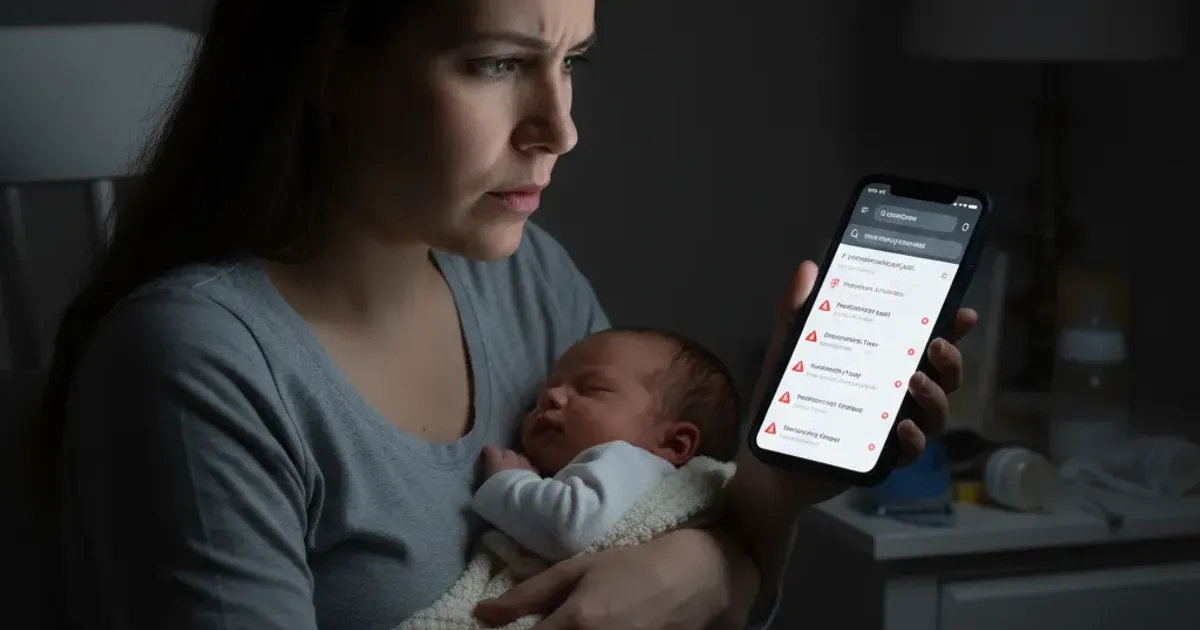
'Dr. Google' is Not Your Pediatrician: How to Manage Postpartum Health Anxiety

Written by
Expert health information, double-checked for accuracy and written to be helpful.
Last updated
Written by
Expert health information, double-checked for accuracy and written to be helpful.
Last updated
The 2 a.m. Rabbit Hole: Searching for Reassurance, Finding Fear
It starts with a simple, worried thought. “Is this rash normal?” “Why did the baby make that weird breathing sound?” Before you know it, you’re typing symptoms into a search bar. Ten minutes later, you’ve clicked through a dozen medical websites and forums, and you have convinced yourself that your perfectly healthy baby has a rare and life-threatening disease.
This is the treacherous world of "Dr. Google," and for a new parent struggling with postpartum health anxiety, it can be a dangerous and addictive place. You go there seeking reassurance, but you almost always leave with more fear than you started with. This compulsive searching is a core challenge of , and learning to break the cycle is essential for your peace of mind.
Why "Dr. Google" is So Tempting for New Parents
You are responsible for a fragile new life, and it is normal to have questions and concerns. The internet promises instant answers at any time of day or night. It feels responsible to "just check" and make sure everything is okay.
The Vicious Cycle of Health Anxiety and "Dr. Google"
Health anxiety is a form of anxiety that is characterized by an excessive and irrational worry about having a serious medical condition. In the postpartum period, this anxiety is almost always focused on the baby.
How Searching for Symptoms Makes Anxiety Worse
The internet is not a medical professional. It cannot take into account your baby's specific context. It simply provides a list of all possibilities, from the most common and benign to the most rare and catastrophic. Your anxious brain is naturally wired to latch onto the worst-case scenario, ignoring the more probable, less scary explanations.
The Problem with "Cyberchondria"
This cycle of escalating health fears fueled by online searches has a name: cyberchondria. It works this:
- The Trigger: You notice a minor, ambiguous symptom.
- The Search: You search for the symptom online.
- The Catastrophe: The search results present you with a terrifying, worst-case scenario.
- The Anxiety Spike: Your anxiety skyrockets, producing real (like a racing heart), which you then misinterpret as further evidence of the terrible disease.
- The Compulsive Search: You search for more information to try and relieve the anxiety, and the cycle begins again, stronger this time.
Strategies to Break the Cycle
1. The "One Trusted Source" Rule
Choose one and only one evidence-based, reputable source for medical information online (like the American Academy of Pediatrics' HealthyChildren.org). If your question can't be answered there, it's time to move to the next step.
2. The "Call the Nurse Line" Rule
Your pediatrician's office has a nurse advice line for a reason. They are trained professionals who can take your baby's specific context into account and tell you if a symptom is a normal variation or something that needs to be seen. Make a rule that you will call the nurse line before you turn to Google.
3. The "Write it Down" Technique
When you have a non-urgent worry, write it down in a notebook. Keep a running list of questions to ask the doctor at your next scheduled appointment. This can help you contain the worry and resist the urge to search for an immediate, and likely inaccurate, answer.
Addressing the Root of the Fear
It's Not About Information; It's About Intolerance of Uncertainty
The compulsive need to search is often driven by an intolerance of the inherent uncertainty of parenthood. You are trying to find a guarantee that your baby will be safe, but no such guarantee exists. The true work of healing from health anxiety is learning to sit with the discomfort of not knowing. This is a core focus of therapy for .
You Can Learn to Trust Again
You can learn to trust your pediatrician. You can learn to trust your own parental intuition. And you can learn to trust that you are a good, caring parent, even without having all the answers. Breaking the cycle of "Dr. Google" is a powerful step in reclaiming your peace of mind and learning to be present with your child, rather than constantly worrying about their future.
If you are struggling with postpartum health anxiety and compulsive searching, schedule a free, confidential consultation with a Phoenix Health care coordinator to find a therapist who can help you break the cycle.
Frequently Asked Questions
- Googling is a compulsion driven by anxiety, each search provides brief relief before generating new fears, which prompt more searching. It's a self-reinforcing cycle. The internet is also a terrible diagnostic tool: it's optimized for engagement, not accuracy.
- It's a common manifestation of PPA specifically, the anxiety latches onto the baby's health as its object. The underlying mechanism is the same: overactive threat detection seeking certainty it can never fully find. Treating the anxiety is more effective than trying to stop googling directly.
- A general rule: if your pediatrician is not concerned after an examination, the internet is not more reliable. A symptom that has been evaluated and dismissed by a physician is not more dangerous because WebMD mentions it.
- Delay and reduce rather than eliminate cold turkey. Set a rule: call the pediatrician before googling. Set a time limit on searches. Recognize the post-search anxiety spike as feedback that googling isn't helping. CBT directly targets this pattern.
- When it's consuming significant time, driving repeated unnecessary medical visits, disrupting sleep, or causing significant distress despite reassurance, that's postpartum health anxiety requiring treatment, not just information. Our article on postpartum health anxiety helps you calibrate.
Ready to get support for Postpartum Anxiety?
Our PMH-C certified therapists specialize in Postpartum Anxiety and can typically see you within a week.
Not ready to book? Dr. Emily writes a short email series on Postpartum Anxiety, honest and practical, from a PMH-C therapist who's been through it herself.
No spam · Unsubscribe anytime