Postpartum Depression in San Antonio: What Military Families Need to Know

Written by
Expert health information, double-checked for accuracy and written to be helpful.
Last updated
Written by
Expert health information, double-checked for accuracy and written to be helpful.
Last updated
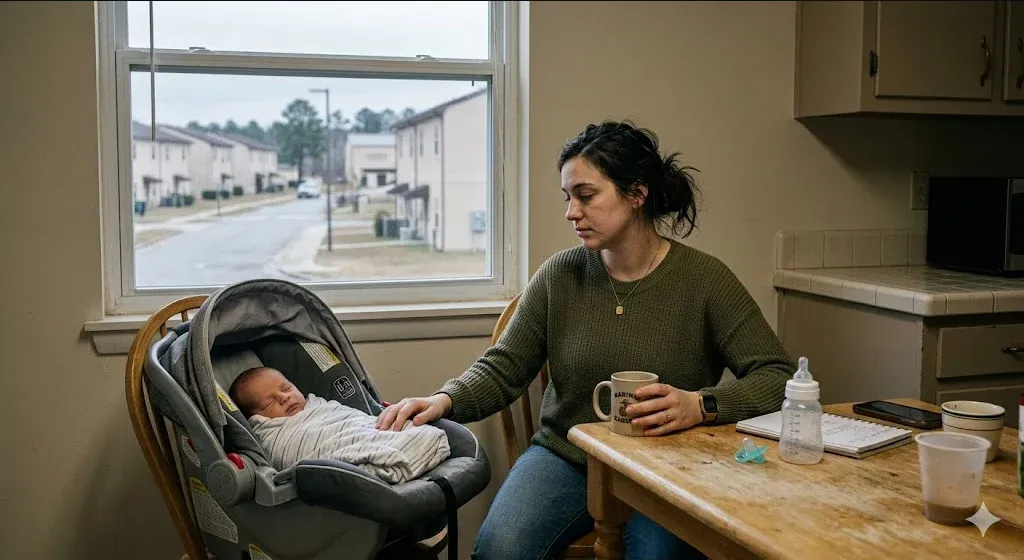
Your partner deployed six weeks before your due date. You gave birth with a nurse holding your hand instead of the person you planned on. By the time they were back, the baby was three months old, and you had been managing alone long enough that you stopped knowing how to let someone help.
This is not a clinical description of postpartum depression. It is the shape postpartum depression often takes in military families, and it is poorly served by the mental health system's standard assumptions about what the postpartum period looks like.
How Postpartum Depression Shows Up Differently for Military Spouses
Postpartum depression has a standard clinical presentation: low mood, loss of interest, fatigue, difficulty bonding with the baby, feelings of worthlessness or guilt, anxiety. But the conditions under which it develops, and the cultural context in which it goes named or unnamed, vary significantly.
For military spouses in San Antonio, across Lackland, Fort Sam Houston, and Randolph, the postpartum period frequently involves partners who are absent or recently returned from deployment, a support network that may have relocated in the last PCS, and a cultural framework inside military communities that defines strength as not needing help. Asking for mental health support in that environment carries a specific weight that civilian frameworks rarely account for.
The result: military spouses underutilize mental health care during the postpartum period at higher rates than civilian spouses, even when symptoms are clinically significant. They tend to present for care later, when symptoms have compounded. They are more likely to minimize what they are experiencing.
Deployment Timing and the Postpartum Window
Postpartum depression does not require a particular trigger. But the conditions of military life during the perinatal period reliably create circumstances in which it develops and deepens: social isolation, unpredictable partner availability, frequent moves, and the absence of the informal daily support network that functions as invisible mental health infrastructure for civilian families.
A deployment that overlaps with the third trimester or the first three months postpartum is the highest-risk configuration. The partner who is supposed to be co-regulating the newborn chaos is not there. The support system from the last duty station is in a different time zone. The family who would have come is too far to come easily.
Postpartum depression that develops under these conditions is not a sign of weakness or inadequacy. It is a statistically predictable response to a genuinely hard set of circumstances.
What Treatment Looks Like and Why It Works
Postpartum depression is fully treatable. The majority of people who receive appropriate, timely care see significant improvement within weeks. The research consistently shows that earlier intervention leads to faster, more complete recovery, and that postpartum depression that goes untreated can persist for a year or longer.
First-line treatment for mild to moderate postpartum depression is therapy, often cognitive behavioral therapy (CBT) or interpersonal therapy (IPT), both of which have strong evidence specifically for the postpartum period. PMH-C certified therapists, those holding the Perinatal Mental Health Certification from Postpartum Support International, have specific training in these protocols and in the ways postpartum mood disorders differ from standard clinical depression.
For moderate to severe symptoms, a combination of therapy and medication is often recommended. Your OB or primary care provider can address the medication component; a perinatal therapist addresses the therapy component.
TRICARE Coverage for Telehealth Mental Health
TRICARE covers telehealth mental health sessions for active-duty service members, their dependents, and many veterans. The coverage applies to video-based sessions with providers enrolled with TRICARE and licensed in the state where the beneficiary is located.
This matters for San Antonio military families because it removes the access barrier that civilian families face. You do not need to get on a four-to-eight-week wait list at a local in-person practice. A telehealth practice that accepts TRICARE can typically schedule an intake within one to two weeks, with sessions by secure video from wherever you are, Lackland housing, an apartment near Randolph, anywhere in San Antonio.
Before your first appointment, confirm that the practice is TRICARE-enrolled and licensed to provide telehealth in Texas. A legitimate practice will verify your specific TRICARE benefits and tell you your cost share before you pay anything.
When to Reach Out
Military culture tends to set the bar for help-seeking very high, you reach out when it's an emergency, not when something is hard. That standard actively works against postpartum mental health, because the window where intervention is most effective is before you hit an emergency.
If the postpartum period feels harder than it should, if you are not sleeping even when you could, if the worry is constant, if you feel disconnected from your baby or your own life, if you are more irritable than you recognize, if something just feels wrong, that is enough reason to reach out.
The 988 Suicide and Crisis Lifeline is available 24/7 by call or text. Postpartum Support International has a helpline at 1-800-944-4773 and peer support volunteers who have been through postpartum mental health challenges themselves.
Starting care earlier does not mean you are weaker. It means you recover faster.
Frequently Asked Questions
- Yes. TRICARE covers telehealth mental health sessions for active-duty dependents in Texas. Phoenix Health accepts TRICARE and typically schedules within one to two weeks, faster than most in-person practices near the bases.
- TRICARE Prime requires a referral from your Primary Care Manager before starting specialty mental health care. TRICARE Select allows you to self-refer to in-network providers. Phoenix Health confirms your specific TRICARE plan and any referral requirements before your first session.
- Military spouses face a specific postpartum configuration: partners who may be absent during the hardest weeks, frequent moves that sever support networks, and a cultural framework that equates strength with not seeking help. These conditions reliably increase postpartum depression risk. It is not a sign of weakness.
- For some people, mild symptoms improve over time. For most, especially under the stressors of military life, postpartum depression persists and often deepens without intervention. The research is consistent: earlier treatment produces faster, more complete recovery. Without treatment, postpartum depression can persist for a year or longer.
- PMH-C stands for Perinatal Mental Health Certification, awarded by Postpartum Support International. Therapists with this credential have specific training in postpartum depression, perinatal anxiety, and birth trauma. For military families, working with a PMH-C therapist who also understands TRICARE and military culture is particularly important.
Ready to get support for Postpartum Depression?
Our PMH-C certified therapists specialize in Postpartum Depression and can typically see you within a week.
Not ready to book? Dr. Emily writes a short email series on Postpartum Depression, honest and practical, from a PMH-C therapist who's been through it herself.
No spam · Unsubscribe anytime