Postpartum Isolation: Why the Village Disappeared and How to Rebuild It

Written by
Expert health information, double-checked for accuracy and written to be helpful.
Last updated
Written by
Expert health information, double-checked for accuracy and written to be helpful.
Last updated
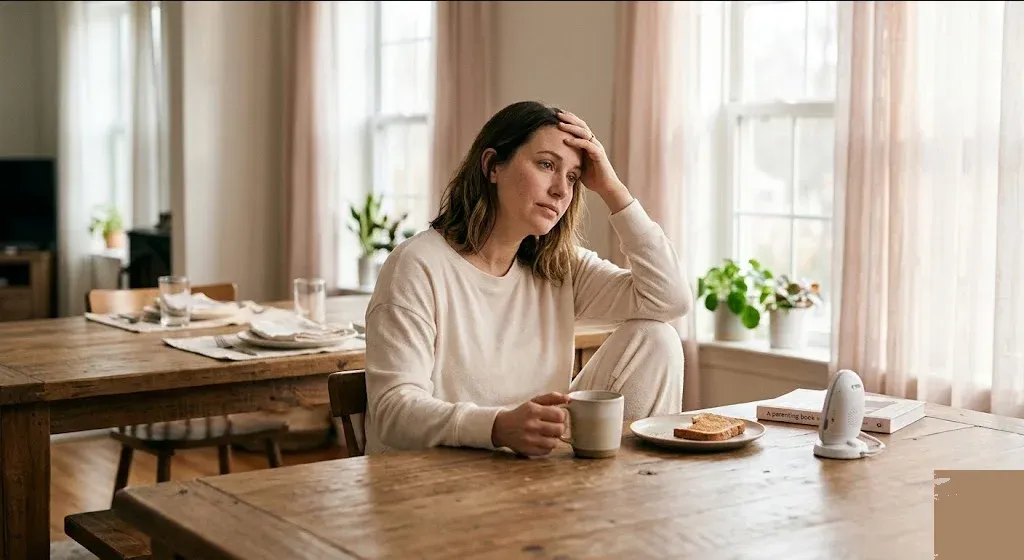
You came home from the hospital with a baby, and three days later, everyone else went home too. Your mother flew back. Your sister returned to work. Your partner's leave ended. The group texts quieted. And there you were, alone in the house in a way that felt nothing like alone had ever felt before. You'd been told it takes a village. Looking around, you couldn't find one.
What you were experiencing is postpartum isolation, and it is not a personal failure. It is the predictable result of a society that primes parents to expect communal support and then provides almost none of it. Understanding what collapsed, and what to do about it, starts with naming the structural problem first.
Why So Many New Mothers Feel Isolated
In 2025, 70% of mothers reported that parenthood was lonelier than they imagined. Twenty percent say they feel this daily. This is not a generation of people who are bad at connecting. It is a generation of people who became parents in conditions that make connection structurally difficult.
Only 3.7% of U.S. households were multigenerational as of 2022, the lowest rate since 2010. The extended family proximity that historically provided postpartum support has largely disappeared. Half of U.S. grandparents live more than an hour from their closest grandchild.
The contrast with other countries is concrete. Finland's perinatal care system surrounds new parents with psychosocial support from early pregnancy. Community health visits are standard, along with access to social workers and psychologists, and a state-issued package of newborn essentials at 22 weeks of pregnancy. Finland's maternal mortality rate sits at approximately 3 per 100,000 live births. The U.S. rate more than doubled between 1987 and 2016, reaching 16.9 per 100,000. That gap reflects a country that concentrates resources on the birth event and then largely withdraws.
American parents are discharged from the hospital and expected to manage physiological recovery, lactation, sleep deprivation, and a full psychological transformation with minimal infrastructure. The village did not disappear because of something you did. It was dismantled before you arrived.
The Science of Why You Need a Village
Human infants are unusually dependent. They take years to reach independent mobility, require constant feeding, and cannot self-regulate. For most of human evolutionary history, the energy required to keep them alive exceeded what one or two adults could reliably provide alone.
Anthropologist Sarah Blaffer Hrdy's research on cooperative breeding documents how humans are uniquely adapted to share child-rearing across multiple caregivers. Hrdy's work shows that human infants evolved specific behaviors to solicit investment from adults beyond the biological mother. Sustained eye contact, early smiling, and extended babbling are evolutionary mechanisms for distributing the caregiving load across a wider network, not expressions of personality.
The Grandmother Hypothesis proposes that human females evolved to live decades past reproductive age specifically to function as alloparents for their grandchildren. The nuclear family model, two adults bearing the full load in isolation, is a recent historical experiment. You are not struggling because you're doing it wrong. You are struggling because the design assumptions have changed.
What Isolation Does to Your Mental Health
The clinical data on social support and postpartum depression is direct. A prospective study tracking mothers from early pregnancy to six weeks postpartum found that low perceived social support raises the risk of developing postpartum depression by 1.63 to 2.21 times compared to well-supported peers. Two things in that finding matter. First, it is perceived support, not the actual number of people around you. A mother with family nearby who offer mostly criticism has low perceived support. A mother with one close friend who shows up reliably may have high perceived support. Quality and attunement count more than headcount.
Second, the mechanism is physiological. When social support is absent and stress is sustained, the hypothalamic-pituitary-adrenal axis stays activated. Cortisol levels remain elevated. Sleep deteriorates. The prefrontal cortex, which handles emotional regulation and decision-making, loses functional capacity. That is what a brain under sustained stress without adequate recovery looks like.
There is also a clinical distinction worth naming. Sometimes isolation is the cause of depression. The structural deficit triggers a depressive episode through chronic stress. Other times, depression arrives first, biochemically driven by the rapid postpartum drop in estrogen and progesterone, and isolation is a symptom. The depressed person withdraws, stops reaching out, hides. That distinction matters for treatment. The final section of this guide returns to it.
Online Support vs. In-Person: What the Research Shows
The assumption is that in-person support would be more effective than virtual alternatives. The research finds the opposite. A meta-analysis comparing digital and in-person mental health interventions for postpartum depression found a mean effect size of -0.86 for digital interventions and -0.55 for in-person. Digital outperformed, by a meaningful margin.
The reason is access. In-person support requires leaving the house, arranging transportation, finding care for older children, and adhering to a fixed schedule. For someone three weeks postpartum who is physically recovering, getting out the door is not a minor hurdle. Virtual groups eliminate that barrier. Parents attend while feeding, while resting, in whatever state they are in. Consistent participation becomes feasible.
The benefit of digital access does not apply uniformly to all online engagement. Clinically moderated virtual groups, where a trained facilitator guides discussion and monitors for clinical signals, consistently outperform unstructured alternatives. Unmoderated social media use by new parents shows the reverse. Research on parenting-related social networking finds that curated content drives upward social comparison, decreases parenting confidence, and is associated with depressive symptoms. The difference between a PSI Zoom group and an Instagram parenting feed is not just format. It is whether someone is managing the room.
Free Support Groups That Can Help
Postpartum Support International (PSI) runs more than 60 free online postpartum support groups weekly. All groups are held via Zoom and facilitated by trained peer supporters who have lived experience with perinatal mood and anxiety disorders. PSI's group schedule, including specialized communities for BIPOC birthers, South Asian mothers, queer parents, and Spanish-speaking families, is at postpartum.net/get-help/psi-online-support-meetings. For in-person options, the local chapter directory at postpartum.net/get-help/locations lists community coordinators and support groups by state.
The PSI HelpLine at 1-800-944-4773 connects parents with trained volunteers who provide resources, referrals, and support. The line is available in English and Spanish. For immediate psychiatric emergencies, the National Maternal Mental Health Hotline is available 24 hours a day at 1-833-943-5746.
How to Build Your Village from Scratch
Structured community programs produce measurable results. The Program for Early Parent Support (PEPS) facilitates peer cohorts of parents with similarly aged infants. Participants reported a 15% increase in perceived social support and a 23% increase in child development knowledge after completing the program. Ninety-six percent agreed the experience increased their confidence as parents.
Public libraries offer something that is often overlooked. Baby storytimes have been documented by public health researchers as effective maternal health interventions. The primary benefit is not literacy development. It is the predictable, recurring structure of being around other adults dealing with the same things in the same neighborhood.
One skill that helps is learning to request the right kind of support. Friends and family typically want to hold the baby, which is pleasant but does not reduce the functional load. The more effective request is specific: a meal dropped off, a grocery run, 30 minutes with the baby while you shower. Asking for the unglamorous thing is harder. It is also what actually changes something.
If postpartum isolation is accumulating over weeks without resolution, understanding when isolation contributes to parental burnout is useful. The pattern has a specific shape, and recognizing it before reaching that point changes the intervention options.
When Isolation Needs More Than Community
There is a version of postpartum isolation that community can resolve. When the primary driver is the structural absence of a village, the treatment is building one. Joining a PSI group, finding a local parent cohort, and rebuilding connection deliberately all work because they address the root cause.
There is another version that requires more than community. When postpartum depression arrives through the biological pathway, triggered by the rapid postpartum drop in estrogen and progesterone, its core features include anhedonia, the loss of capacity for pleasure, and withdrawal from connection. Depression at this level biochemically impairs the ability to receive what community offers. A person experiencing severe PPD cannot attend a support group and simply feel better. Understanding when isolation tips into depression and what distinguishes the two patterns changes what to do next.
In biologically driven cases, clinical support comes first. Psychiatric evaluation, medication if indicated, individual therapy to restore baseline functioning. Once that baseline exists, community support becomes a powerful complement. The sequence matters. Trying to treat biochemically driven depression with peer support alone is asking someone to reach for a rope they cannot feel.
There is a practical signal worth watching. If you have joined groups and felt nothing, if you are around people and remain completely flat, if things are worsening rather than plateauing over weeks, that points toward clinical evaluation rather than more community effort. The emotional experience of postpartum loneliness has its own shape. When that emotional experience is accompanied by biological depression, the path forward is different.
Postpartum depression responds well to treatment, and the right sequence matters. A perinatal therapist understands whether isolation is driving the depression or depression is driving the isolation, and that distinction shapes everything that follows. Perinatal-specialized training is meaningfully different from general therapy because it covers the neurobiology of the fourth trimester and the social conditions that amplify mood disorders. Most Phoenix Health therapists hold PMH-C certification from Postpartum Support International, the clinical credential for perinatal mental health. If you're ready to talk to someone who already understands the terrain, our postpartum depression therapy page connects you with therapists who specialize in exactly this.
Frequently Asked Questions
- Yes. In 2025, 70% of mothers reported that parenthood was lonelier than they imagined, with 20% saying they feel this daily. This reflects something structural rather than personal. Having a baby tends to remove the key conditions for adult connection at exactly the moment demands are highest: routines disappear, careers pause, peer networks contract, and the extended family support most parents expected rarely materializes the way they imagined. The village proverb is real, but the village has largely been dismantled by geographic dispersion, the decline of multigenerational households, and a healthcare system that provides almost no postpartum support infrastructure. Postpartum isolation is the predictable outcome of raising children in these conditions. It is not a reflection of your relationships or your resilience.
- Postpartum Support International (PSI) offers more than 60 free online postpartum support groups weekly, facilitated by trained peer supporters with lived experience of perinatal mood and anxiety disorders. Groups cover general postpartum depression and anxiety, as well as specialized communities for BIPOC birthers, South Asian mothers, queer parents, and Spanish-speaking families. All are free and held via Zoom. The full schedule is at postpartum.net/get-help/psi-online-support-meetings. For in-person options, PSI's local chapter directory lists community coordinators by state. The Program for Early Parent Support (PEPS) runs facilitated peer cohorts for parents of similarly aged infants, primarily in the Pacific Northwest. The characteristic that matters most in any group is facilitation: moderated groups consistently produce better outcomes than unstructured online communities.
- Research finds that mothers with low perceived social support face 1.63 to 2.21 times the risk of developing postpartum depression compared to well-supported peers. The mechanism is physiological: chronic stress without social buffering keeps the hypothalamic-pituitary-adrenal axis activated, elevates cortisol, disrupts sleep, and reduces the prefrontal capacity needed for emotional regulation. The relationship also runs in both directions. Isolation can cause depression when the structural deficit triggers a depressive episode. Depression can also cause isolation when a biologically driven episode produces withdrawal and self-hiding as symptoms. A provider can help identify which pattern is primary, which changes the treatment sequence. If isolation is the driver, community is the treatment. If biological depression came first, clinical support comes first.
- Start with structured, facilitated groups designed specifically for new parents. PSI offers more than 60 free weekly online groups accessible from anywhere. For in-person options, PEPS programs and library baby storytimes create recurring contact with parents in the same geographic area and life stage. Building a village also requires practicing a specific kind of asking. People who want to help usually default to holding the baby. What actually reduces the load is something more specific: a meal dropped off, a grocery run, 30 minutes of coverage while you shower. Asking for the unglamorous thing is harder than asking for the baby hold. It is also what changes something. One specific request to one safe person is where to start.
- Two signals warrant clinical evaluation rather than continued self-management. First: if you have tried community approaches, joined groups, reconnected with people, and still feel completely flat, that flatness may indicate depression rather than isolation. Depression biochemically impairs the ability to process connection, so community alone will not resolve it. Second: if things are worsening rather than plateauing over weeks, specifically persistent sadness, loss of interest in things that used to matter, difficulty bonding with your baby, or thoughts of harming yourself. If you are having thoughts of harming yourself, call or text 988 for immediate support. A perinatal therapist understands the difference between isolation as cause and depression as cause, and that distinction shapes the treatment sequence. Starting earlier produces faster and more complete recovery than waiting.
Ready to get support for Postpartum Depression?
Our PMH-C certified therapists specialize in Postpartum Depression and can typically see you within a week.
Not ready to book? Dr. Emily writes a short email series on Postpartum Depression, honest and practical, from a PMH-C therapist who's been through it herself.
No spam · Unsubscribe anytime