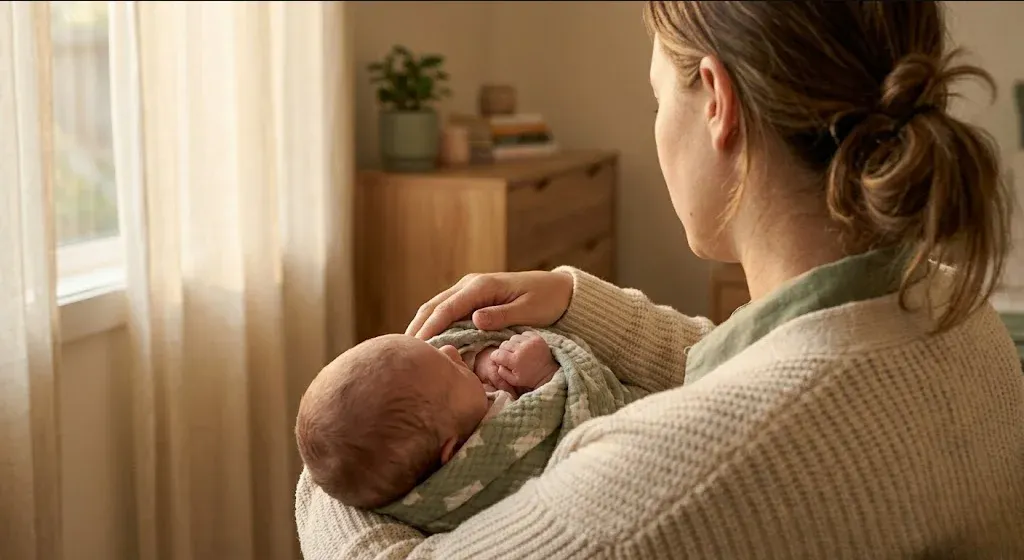
Single Parenthood and Perinatal Mental Health: Risk, Protection, and Support

Written by
Expert health information, double-checked for accuracy and written to be helpful.
Last updated
Written by
Expert health information, double-checked for accuracy and written to be helpful.
Last updated
The ultrasound is on the screen. You're alone in the room with the technician and the dark image of your baby, and the forms, the conversations, the chairs in the waiting room - all of it designed for two people. You're doing it for one.
About 40% of all births in the United States are to unmarried women, according to CDC data. Solo pregnancy is not unusual. But the particular experience of it - managing every decision, every sleepless night, every medical appointment as a single system - creates structural pressures that research has only recently started to document clearly. The risks are real. They're also explainable. And that matters, because what's explainable is usually addressable.
Being an Unpartnered Parent Is Not One Experience
The category of 'single parent' covers genuinely different situations. Some people are managing an unplanned pregnancy where a partner is absent, ambivalent, or actively unsupportive. Some are single mothers by choice - women who made deliberate, often long-planned decisions to conceive using donor sperm or reproductive technology, knowing from the start they would parent alone. Some people's relationships ended during pregnancy or the early postpartum period. And some are technically partnered but functionally solo because their partner is emotionally absent or uninvolved.
Research from Susan Golombok's group at the University of Cambridge, tracking single mothers by choice over time, found that children in these families showed healthy psychological adjustment and strong attachment. Mother-child relationships in intentional solo-parent families were characterized by high warmth and lower conflict than in two-parent families. The structure of single parenthood, absent other adversities, does not determine the outcome.
What each of these situations shares is structural: one person absorbing a load that the dominant parenting model divides between two. The risks that come with solo parenting come primarily from that structural reality. Understanding which type of situation you're in matters for understanding both the vulnerabilities and what actually protects against them.
The Mental Health Risk Is Real and Structural
The data on mental health disparities between single and partnered parents is consistent. Brookings Institution analysis of National Health Interview Survey data found that about 32% of single mothers experience moderate or severe psychological distress, compared to 19% of married mothers. Single mothers are more than three times as likely to report severe psychological distress - 7% compared to 2% of married mothers. Even after accounting for differences in income, race, and health status, the gap persists.
This disparity is not a character issue. Several interlocking mechanisms drive it.
Financial insecurity sits at the center. Single mothers have poverty rates roughly four times higher than married mothers. Chronic financial strain activates the HPA axis - the body's core stress-response system - and sustained HPA activation increases vulnerability to both depression and anxiety. The Brookings analysis found a clear implication: each additional ,000 per year in state safety-net benefit generosity (through programs like the Earned Income Tax Credit, SNAP, or Medicaid) measurably reduces severe psychological distress among single mothers. Financial security has direct clinical implications, not just quality-of-life ones.
Sleep deprivation compounds everything. Postpartum care without a co-parent sharing night shifts means severe, prolonged sleep fragmentation. The prefrontal cortex - the brain region responsible for emotional regulation - loses function rapidly under sustained sleep deprivation. Stressors that would be manageable with adequate sleep become overwhelming without it.
The third mechanism is the absence of emotional buffering. Partners in paired households absorb some of the daily stress of new parenthood by listening, co-processing difficult moments, and providing real-time validation. Without that buffer, solo mothers process everything internally. Perceived social support is one of the strongest documented protective factors against postpartum depression. Its absence is a corresponding risk.
The Specific Texture of Gestational Loneliness
There's a particular kind of loneliness that belongs to solo pregnancy. Obstetric appointments, genetic screenings, ultrasounds: all of these are typically framed as joint experiences. Managing them alone, without a person to process the clinical information with in real time, produces something that's hard to name. Not exactly sadness. Something closer to being absent from your own significant moments.
For people managing relational uncertainty during pregnancy - a partner who may or may not be involved, who keeps changing their position - the psychological drain is chronic. Rather than preparing for parenthood, cognitive energy goes toward contingency planning: what if he doesn't come to the birth, what if the financial support disappears after delivery. This kind of relational scanning is exhausting, and it keeps the nervous system in a low-grade threat state throughout pregnancy.
Postpartum isolation, which affects most new parents to some degree, tends to run particularly deep for solo parents. There is no one sharing the reference frame of your specific baby. No one awake with you at 3 a.m. Postpartum loneliness in this context is not a personality problem or a failure to connect. It's what happens when the structural conditions for connection have been removed, and it deserves attention on its own terms.
What Actually Protects Against PMADs
The protective factors in the research on solo parent mental health are specific, and some of them are actionable before the baby arrives.
Financial security reduces PMAD risk directly, not through some indirect mood pathway, but by removing a primary biological stress driver. Connecting with available support structures - EITC, SNAP, Medicaid, state paid family leave, and Legal Aid for custody and child support questions - is clinical-level protection. Financial stress during the perinatal period has documented effects on HPA axis function and PPD risk. Reducing it is not just practical; it's protective.
Strong social networks matter most when they're concrete and reliable. 'Let me know if you need anything' does not help. Specific people committed to specific roles - childcare during appointments, food during the first weeks, someone available to call at 11 p.m. - provide something functionally close to the emotional buffering that a co-parent would otherwise provide. Building these commitments before the baby arrives matters far more than trying to organize them after.
For single mothers by choice specifically, the data on prior planning is notable. Because SMCs typically organize financial and social support well before conception, their perinatal mental health trajectories track much closer to those of partnered mothers than to those of unpartnered mothers in other circumstances. Prior planning is not just practical preparation; it's psychological protection.
Resources for Solo Parents
Postpartum Support International offers a free virtual weekly support group specifically for unpartnered and solo parents. These are facilitated, structured groups - not open forums - designed for genuine peer connection. The PSI HelpLine (1-800-944-4773) connects callers to local providers and community resources at no cost, and it's available in English and Spanish.
Single Mothers by Choice, founded in 1981 by Jane Mattes, LCSW, provides online forums, local chapters, and resources specifically for women who chose intentional solo parenthood. For women in this subgroup - or those considering it - the community offers peer connection with people who share the specific texture of that experience.
Doula support is particularly valuable for solo parents, especially during labor and the early postpartum period. California's Medi-Cal program covers doula care for eligible individuals, including up to eight prenatal and postpartum visits, continuous labor support, and postpartum home visits. Other states are expanding Medicaid doula coverage. For those who don't qualify for Medicaid, community doula programs in most cities offer sliding-scale fees.
When to Seek Clinical Help
Feeling overwhelmed, exhausted, and isolated in solo parenthood is an appropriate response to structural conditions. That's not a sign of failing or of deteriorating mental health. The difficulty is real.
The clinical distinction to watch for: if what you're experiencing is primarily about missing external support, and it eases at least somewhat when you have genuine connection, that's closer to situational distress than clinical disorder. But if sadness or flatness persists regardless of what's around you; if anxiety is interfering with eating, sleep, or basic functioning beyond what exhaustion alone explains; if you're struggling to feel connected to your baby after the first couple of weeks; or if you're having thoughts of harming yourself - those warrant a clinical conversation.
If you're having thoughts of harming yourself, call or text 988 (the Suicide and Crisis Lifeline). They support perinatal mental health crises specifically.
The Edinburgh Postnatal Depression Scale is the standard postpartum screening tool. A score of 10 or above typically prompts referral for further evaluation. A score of 1 or above on item 10 (the question about self-harm) is a same-day conversation regardless of the overall score.
Postpartum depression responds well to treatment. So does perinatal anxiety. Getting support earlier rather than waiting for a full crisis produces better outcomes - shorter recovery, less disruption to daily functioning, and less time in the difficult window before improvement. You don't have to be in crisis to reach out.
If you're managing pregnancy or the postpartum period as a solo parent, a perinatal therapist doesn't need a lengthy explanation of why this is hard. The structural demands, the sleeplessness, the absence of a sounding board - these are known clinical realities for therapists trained in perinatal mental health. Most Phoenix Health therapists hold PMH-C certification from Postpartum Support International, the clinical credential specifically for perinatal mental health. When you reach out, you don't have to start from the beginning. Our postpartum depression therapy page connects you with therapists who already understand what you're dealing with.
Frequently Asked Questions
- Yes, and the risk elevation is substantial. Research using National Health Interview Survey data found that about 32% of single mothers experience moderate or severe psychological distress compared to 19% of married mothers. Single mothers are more than three times as likely to report severe psychological distress. The gap persists even after accounting for income, race, and health status. The primary drivers are structural: financial insecurity activates the HPA axis in ways that increase depression and anxiety risk; sleep deprivation without a co-parent sharing night shifts impairs emotional regulation; and the absence of a partner as an emotional buffer means solo mothers absorb all daily parenting stress internally. These are structural vulnerabilities, not personal ones. They're also partially addressable - financial supports, strong social networks, and early professional care each reduce the risk meaningfully.
- Single mothers by choice (SMCs) - women who intentionally conceived alone through donor sperm or reproductive technology - have mental health profiles much closer to those of partnered mothers than to those of unpartnered mothers in other circumstances. Research from Susan Golombok's group at Cambridge found that SMC children showed healthy psychological adjustment and strong attachment, and mother-child relationships in SMC families were characterized by high warmth and lower conflict than in two-parent families. The key protective factors for SMCs are prior planning and established support structures. Because SMCs typically organize financial stability and social support before the baby arrives, they reduce the primary structural vulnerabilities that drive PMAD risk in other unpartnered parents. The structure of intentional solo parenthood, absent economic hardship and social isolation, does not produce worse mental health outcomes.
- Several free resources are specifically designed for solo parents. Postpartum Support International (postpartum.net) offers a free virtual weekly support group for unpartnered and solo parents, facilitated by trained peer supporters in a structured format designed for genuine connection. Their HelpLine (1-800-944-4773, English and Spanish) provides immediate support and referrals to local providers. For acute mental health crises or thoughts of self-harm, 988 (the Suicide and Crisis Lifeline) provides free, confidential support with specific perinatal expertise. For women who intentionally chose solo parenthood, Single Mothers by Choice (founded by Jane Mattes, LCSW) offers online forums and local chapters. Telehealth therapy options have significantly reduced the logistical barriers to clinical care for solo parents who face childcare and transportation challenges.
- A perinatal therapist - particularly one with PMH-C certification from Postpartum Support International - already understands the clinical landscape of solo parenthood. You don't need to spend intake sessions explaining what the postpartum period is like or why being without a partner makes it harder. The PMH-C credential specifically trains clinicians in perinatal mood disorders, the structural vulnerabilities of different family configurations, and the particular emotional terrain of solo parenting. When searching for a therapist, filtering for perinatal specialization or PMH-C certification reduces the amount of context you'll need to provide. Phoenix Health therapists work via telehealth, which removes the logistics barrier of childcare and transportation that often prevents solo parents from seeking support.
- Yes. Attachment security is determined primarily by the quality and consistency of caregiving - specifically, responsive, sensitive parenting - not by household structure. The landmark NICHD research on childcare and attachment established that maternal sensitivity is the primary determinant of attachment security, and that family structure alone does not predict attachment outcomes. Research on single mothers by choice families confirms this directly: children in intentional solo-parent families show healthy psychological adjustment and secure attachment at rates comparable to two-parent families. The conditions that support secure attachment - emotional availability, consistent responsiveness, a parent who can regulate their own stress - are the same conditions supported by addressing PMAD risk early. A parent whose mental health is stable and supported is more able to provide the responsive caregiving that builds secure attachment.
Ready to get support for Postpartum Depression?
Our PMH-C certified therapists specialize in Postpartum Depression and can typically see you within a week.
Not ready to book? Dr. Emily writes a short email series on Postpartum Depression, honest and practical, from a PMH-C therapist who's been through it herself.
No spam · Unsubscribe anytime