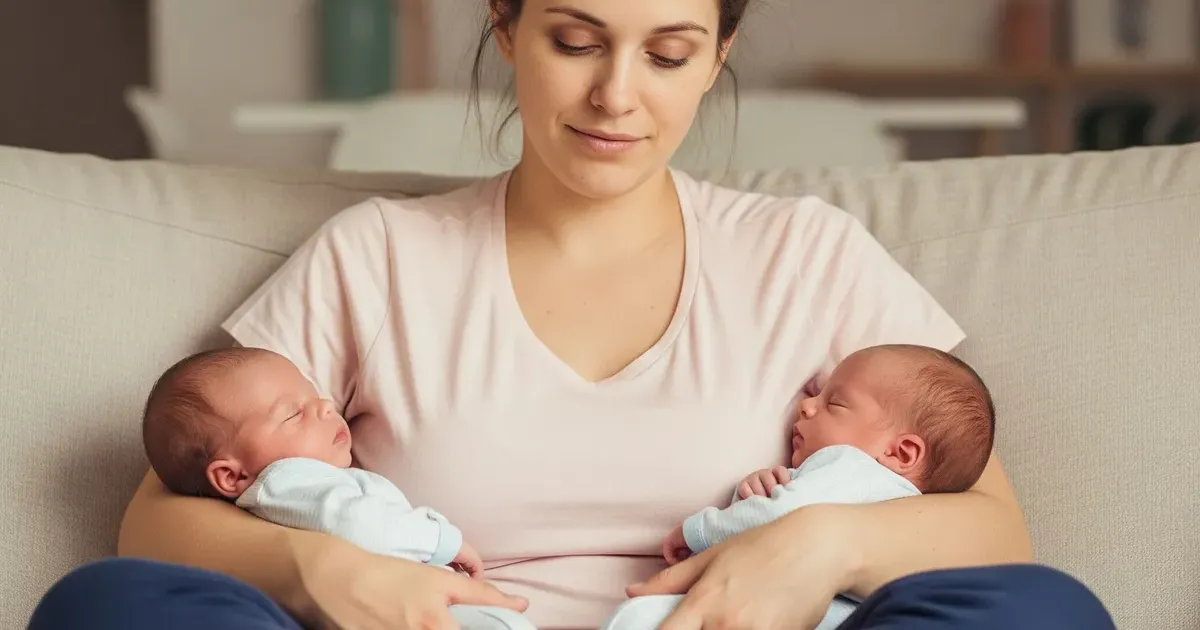
A Mental Health Guide for Mothers of Multiples

Written by
Expert health information, double-checked for accuracy and written to be helpful.
Last updated
Written by
Expert health information, double-checked for accuracy and written to be helpful.
Last updated
The Elevated Risk Profile: Understanding the Data on Twin Mom Mental Health
Mothers of twins and higher-order multiples are not just "more tired" or "busier" than other parents. Research shows they represent a clinically distinct group with a higher risk of developing a range of perinatal mood and anxiety disorders (PMADs). This elevated risk is not a reflection of a mother's capability or love for her children. It is a direct consequence of a unique combination of physical, mental, and social stressors that come with raising multiples.
An Evidence-Based Overview of Increased Risk
Quantitative studies consistently show that parenting multiples is a significant risk factor for poorer mental health. A comprehensive systematic review and meta-analysis found that mothers of twins have statistically higher scores for both depression and anxiety when compared to mothers of singletons. One study from Johns Hopkins University found that 19% of mothers of multiples reported moderate to severe depressive symptoms nine months after giving birth, compared to 16% of mothers of singletons. Another global survey of over 1.1 million mothers found a similar gap: 11.3% of twin mothers reported postpartum depression symptoms, compared with 8.3% of singleton mothers.
These percentage differences may seem modest. But they represent thousands of women in significant distress and show a consistent, measurable pattern across large populations. The consensus across most investigations is clear: parents of multiples experience heightened symptoms of depression, anxiety, and parenting stress.
The Constellation of Risks: Beyond Postpartum Depression (PPD)
Postpartum depression is the most widely recognized perinatal mood disorder. But the mental health risk for mothers of multiples is more accurately described as a complex web of interconnected challenges.
A landmark Canadian population-based cohort study revealed a particularly stark finding: in the first year after giving birth, mothers of twins have a 21% increased risk of experiencing a severe maternal mental illness. This was defined as an emergency department visit or hospitalization for mental illness, a self-injury event, or death by suicide. This means that for a subset of these mothers, distress does not stay mild or moderate. It escalates to a crisis point requiring urgent medical care.
Mothers of multiples also face a significantly higher likelihood of developing Childbirth-Related Post-Traumatic Stress Disorder (CB-PTSD). Multiple pregnancies are more prone to complications, emergency C-sections, and premature birth. Research shows that giving birth prematurely doubles a mother's risk of developing CB-PTSD. Experiencing obstetrical complications is another primary risk factor. By virtue of their higher-risk pregnancies, mothers of multiples are exposed more often to the events known to cause birth trauma.
The intense, hypervigilant state required to care for two newborns can also create fertile ground for Perinatal Obsessive-Compulsive Disorder (OCD). This condition involves persistent, intrusive, and frightening thoughts (obsessions) and repetitive behaviors (compulsions) performed to reduce anxiety. The condition is known to affect 2-3% of all parents in the perinatal period, with a higher incidence than in the general population. The terrifying recurring thought "what if I drop him?" or the compulsion to check the monitor 100 times each night are real examples of how perinatal OCD can manifest in this high-stress environment.
The mental health burden on mothers of multiples is not a single issue. It is a web of interconnected risks. A high-risk twin pregnancy often leads to heightened anxiety throughout gestation. This anxiety-filled pregnancy is more likely to end in a premature or traumatic birth, which are primary drivers of CB-PTSD. The trauma of the birth, compounded by a potential NICU stay and extreme sleep deprivation, can then trigger or worsen PPD and postpartum anxiety (PPA). These conditions often overlap and influence one another. Mothers of multiples, their partners, and clinicians need to be alert to symptoms across the full PMAD spectrum.
The Critical Window: Timing and Demographics of Risk
The increased mental health risk for mothers of multiples is not permanent. It is most acute within a specific timeframe. The same Canadian study that found the 21% increased risk also found that this elevated risk normalizes after the first year postpartum. This is a key finding. It means that if a mother of multiples can be adequately supported through the first year, her long-term mental health outlook improves significantly.
Within that first year, risk is not spread evenly. A large Danish registry study found that the peak risk for twin mothers to develop PPD occurs sharply around two months postpartum. This is when the demands of caring for two newborns, physical recovery from birth, and hormonal shifts all collide with maximum force.
Certain demographic factors also increase the risk. Large-scale studies have identified first-time mothers and mothers younger than 25 as being at higher risk for PPD. But the most pronounced risk was found in mothers over the age of 40 having twins. 15% of these mothers reported PPD symptoms. That is more than double the rate of singleton mothers in the same age group (6.6%). This combination of advanced maternal age and a multiple birth creates a uniquely challenging situation that warrants heightened attention from healthcare providers.
Addressing Contradictory Evidence: The Power of Support
While most evidence points to elevated risk for twin moms, some studies have found no substantial mental health differences between parents of twins and singletons. One notable study from Italy reached this conclusion. But a closer look reveals a powerful explanation. The researchers themselves note that their study had strict inclusion criteria favoring twin pregnancies with better outcomes. Most importantly, their clinic provided routine mental health support to twin mothers as part of standard care.
This finding does not contradict the broader consensus. It actually supports a crucial point: when healthcare systems proactively recognize the unique challenges of a multiple pregnancy and provide targeted support, mothers of multiples can demonstrate resilience on par with their singleton peers. The problem is not an inherent deficit in the mother. It is a systemic failure to provide the necessary support. The elevated risk is not an inevitable fate. With the right interventions, this risk can be successfully reduced.
Understanding Mental Health Risks in Multiples vs. Singletons
Here is a clear, data-driven summary of the core evidence.
Postpartum Depression (PPD): 11.3% to 19% of mothers of multiples report moderate to severe symptoms, compared to 8.3% to 16% of singleton mothers. Risk peaks sharply around two months postpartum for twin mothers.
Perinatal Anxiety: Mothers of multiples have significantly higher anxiety scores compared to singleton mothers. Multiple pregnancies are inherently high-risk, and this is a major driver of antenatal anxiety.
Severe Mental Illness (First Year): Mothers of multiples experience 10.5 per 1,000 person-years of severe mental illness, a 21% increased risk compared to singleton mothers (8.7 per 1,000). Risk normalizes after the first year.
Childbirth-Related PTSD (Risk Factors): Mothers of multiples have a higher likelihood of premature birth, emergency C-section, and NICU stays. Premature birth, a common outcome for twins, doubles the risk of developing CB-PTSD.
The Crucible of the First Year: A Convergence of Stressors
The elevated mental health risks observed in mothers of multiples are not abstract statistics. They are the direct result of a relentless combination of physical, logistical, financial, and mental stressors. These stressors are most acute during the first year. Understanding the scale and interplay of these challenges is fundamental to appreciating why this population is so vulnerable.
Physical and Logistical Demands: Surviving the Day-to-Day
The daily reality of caring for two or more infants pushes parents to their absolute limits. At the heart of this challenge is profound, chronic sleep deprivation. Research has shown that in the early weeks, mothers of twins sleep an average of only 5.4 to 5.6 hours in a 24-hour period. That sleep is severely fragmented into an average of 15 short episodes, each lasting only about 22 minutes. This is not merely "feeling tired." It is a level of physical disruption directly linked to the development of postpartum depression.
To survive this, parents of multiples are often forced to adopt what can only be described as the tyranny of the schedule. Feeding and sleep routines are not just useful organizational tools. They are critical mental health survival strategies. The "golden rule" for feeding twins, waking the second baby to eat as soon as the first wakes, is a perfect illustration of this relentless reality. While this synchronization is necessary to create any possibility of rest, it eliminates the natural lulls and breaks that a mother of a singleton might experience. There is no downtime. The cycle of feeding, changing, and settling two infants is continuous.
This logistical intensity extends beyond the home. Personal stories illustrate how simple tasks become enormous challenges. One twin mother described how a trip into town takes two to three times longer than for her friends with singletons, simply due to the lack of step-free access for a double stroller. Another described being unable to participate in conversations during lunch because she was constantly "baby-juggling," her food going cold. For some, the effort is so great that it leads to profound isolation. One mother described days when she "hid at home, didn't shower, ate too much chocolate and cried in the bathroom" because getting out the door felt like an insurmountable mountain. These are not minor inconveniences. They are daily, recurring sources of stress and isolation.
The Mental Toll of High-Risk Pregnancy and Birth
The stress for a mother of multiples begins long before the babies arrive. A multiple pregnancy is, by its nature, classified as high-risk. This label brings with it a heavy mental burden. It leads to significantly higher rates of antenatal anxiety and depression compared to singleton pregnancies. Expectant mothers often live with a constant, low-grade fear of complications such as Twin-to-Twin Transfusion Syndrome (TTTS), fetal growth restriction, or preterm labor. This anxiety can be so intense that some mothers feel unable to celebrate their pregnancy or connect with their unborn babies for fear of loss.
This high-risk pregnancy is also more likely to end in a difficult or traumatic birth. Mothers of multiples have a higher chance of requiring medical interventions such as induction or an emergency C-section. They are more likely to deliver prematurely. A premature birth often requires a NICU stay. The NICU environment is widely recognized as a significant trauma for parents. It involves constant worry, stress, and guilt, and it is a known risk factor for developing PPD, anxiety, and PTSD.
The NICU experience for a mother of multiples can create a unique and particularly painful "split reality" trauma. One mother's story illustrates this vividly. With one twin healthy enough to be at home and the other still in the NICU, she was caught in an impossible emotional bind. She felt overwhelming guilt for not being at the hospital with her sick baby, and simultaneously felt guilty for not fully bonding with the newborn she had at home. This creates a state of profound cognitive dissonance. It is a specific and powerful example of the unique trauma that can accompany a multiples birth.
The Weight of Financial Strain
Layered on top of physical and emotional challenges is the immense and chronic stress of financial strain. The "twin tax" is real and significant. It begins at birth and continues for decades. The cost of a twin delivery can be up to five times greater than that of a singleton. The initial outlay for double the gear, car seats, cribs, and strollers can be substantial.
This financial pressure is not a short-term issue. The USDA estimates that the cost for a middle-income family to raise twins from birth to age 17 is nearly half a million dollars. This does not include the cost of college.
This is not just a line item on a family budget. It is a direct risk factor for perinatal mental illness. One study found that 81% of families report feeling stressed and anxious due to financial concerns. 86% say that money worries make parenting harder. The financial pressure can also grow when a mother must delay her return to work, further straining the family's resources. This chronic financial worry acts as a constant, underlying stressor that makes it harder to cope with the other daily challenges of raising multiples.
Key Stressors for Twin Motherhood: A Summary
Logistical and Physical Demands
- Chronic fragmented sleep (averaging 5.4 hours per day in 22-minute bursts)
- The complexity of tandem feeding and rigid schedules
- The sheer difficulty of leaving the house with two infants
Medical and Pregnancy Demands
- Heightened anxiety throughout a high-risk pregnancy
- Increased likelihood of a traumatic birth (emergency C-section)
- High probability of a traumatic NICU stay for one or both babies
Financial Demands
- Significantly higher birth and equipment costs
- Long-term cost of raising two children at once (approximately $490,680)
- Financial pressure from delayed return to work
Social and Mental Demands
- Deep isolation from singleton parent peers who "don't get it"
- Constant, intrusive public commentary and questions from strangers
- Unspoken grief for the singleton experience
- The complex challenge of bonding with two infants at once
The Inner World of a Twin Mom: Unique Emotional Landscapes
Beyond the external, measurable stressors lies a rich and complex internal world unique to mothers of multiples. To truly understand the mental health of a twin mom, one must explore the distinct emotional landscapes she navigates.
The Unspoken Grief: Mourning the Singleton Experience
One of the most powerful, yet least discussed, emotional challenges for many first-time mothers of multiples is grief for the singleton parenting experience they will never have. One mother put it with raw honesty: "it makes me SO SAD I will never get the experience of doting on my first born child." She described feeling angry and "so alone because a singleton parent cannot relate." This feeling is not a rejection of her twins, whom she loves. It is mourning for a different, perhaps simpler, path to motherhood that she had envisioned.
This particular grief can be understood as disenfranchised grief. It is a real and painful loss that is not openly acknowledged or socially validated. Society overwhelmingly frames the birth of twins as a "double blessing." This positive narrative, while well-intentioned, can leave little room for a mother to express feelings of being overwhelmed, terrified, or sad. She may feel she has no right to mourn the one-on-one bonding journey she sees her friends with singletons experiencing. Carrying this grief in silence feeds feelings of guilt and isolation. It makes her think something is wrong with her for feeling this way.
This same sense of a lost, expected family life can also occur in the tragic circumstance of losing one twin. In that case, parents must navigate the complex emotional space of grieving one child while trying to feel joy for the surviving baby.
The Complexities of Bonding with Two
The cultural script for "good mothering" often involves images of deep, focused, uninterrupted one-on-one connection with a newborn. For mothers of multiples, the logistical reality of caring for two infants makes this script nearly impossible to follow. The relentless demand of tandem feeding, double diaper changes, and soothing two crying babies at once means that quiet, snuggling moments are often fleeting or non-existent. This gap between the idealized version of bonding and the chaotic reality of daily life is a significant source of distress and guilt.
This logistical challenge gives rise to another deeply hidden emotional struggle: feeling more connected to one twin than the other. Differential bonding is a common experience, yet it produces intense guilt in mothers who believe they should love and feel connected to both babies equally and identically. Experts emphasize that this is a normal and understandable response to caring for two unique individuals with different personalities, temperaments, and needs. One baby may be an easier feeder, a better sleeper, or have a calmer disposition, naturally making the process of connecting with them feel less stressful. But for a mother steeped in the ideal of perfect maternal love, acknowledging this preference can feel like a terrible failure.
Bonding is a process, not a single event. It can be further complicated and impaired by the trauma of a difficult birth or a stressful NICU stay. The challenge for a mother of multiples is not a failure to bond. It is the need to develop a new, more realistic definition of what successful bonding looks like in the context of her family.
The Erosion of Self: Identity, Isolation, and Social Pressure
The transition to motherhood, a process known as "matrescence," involves a massive shift in a woman's sense of self. For a mother of multiples, this identity shift is amplified and takes on a uniquely public dimension. She does not just become a mother. She becomes "the twin mom," a public identity that can feel all-consuming and defining.
This public identity brings a layer of social management stress not typically experienced by mothers of singletons. From the moment the double stroller leaves the house, her family life becomes a subject of public spectacle. Strangers feel entitled to stop her, ask intrusive questions ("Are they natural?" "Do they run in your family?"), and offer unsolicited comments and advice. Every outing becomes a performance where she must manage not only her children but also the public's curiosity. This is an invisible form of emotional labor that adds to her already significant mental load.
This public role often coexists with a profound sense of private isolation. Many mothers of multiples report feeling deeply disconnected from their friends with singletons, who simply "don't get it." The daily struggles are so different in scale and scope that it creates a chasm of understanding. One mother described how she rarely called friends for support because she did not know how to put the "emotional roller coaster that each day became into words." This leads to the painful paradox of being the center of public attention while feeling utterly alone. The pressure to appear happy and grateful for her "blessing," especially if the twins were the result of a long IVF journey, can further silence her and prevent her from admitting just how much she is struggling.
The Evolving Journey: From Toddlerhood to School-Age and Beyond
While the first year postpartum represents a period of acute crisis for many mothers of multiples, the mental health challenges do not simply vanish as the babies grow. They evolve. The primary work for a mother of multiples often shifts from sheer physical survival to the complex, long-term task of "twin relationship management."
Tandem Tantrums and Toddler Turbulence
The toddler years bring a new level of logistical and emotional complexity. While a mother of a single toddler can focus her attention on one meltdown at a time, a mother of twin toddlers is often faced with "tandem tantrums." Because twins are so attuned to one another, they can feed off each other's behavior, quickly escalating a single moment of frustration into a full-blown, stereo meltdown.
Immediate separation, to break the feedback loop, and distraction are not just helpful tips. They are essential tools for preserving parental sanity. The stress of managing two defiant toddlers at once, especially when one is having a meltdown while the other is "swinging off your legs asking to be picked up," requires a level of patience and emotional regulation that can feel superhuman.
Fostering Individuality: The Core Task of Twin Parenting
As twins move from toddlerhood into their school-age years, the central and most enduring task for their parents becomes fostering each child's individuality. While the deep bond between multiples is a unique source of strength and affection, each child must also be supported in developing a separate and secure sense of self. This process is far more complex than for singleton siblings.
Parents of multiples are advised by experts to actively work against the world's tendency to treat their children as a single unit. This involves a series of conscious, often tiring parenting choices: using their individual names rather than calling them "the twins," avoiding dressing them alike, providing separate toys and even separate birthday cakes, encouraging different hobbies and interests, and ensuring they have one-on-one time away from their sibling.
This creates a unique mental load for the mother. She must often parent in a way that is counter-intuitive to "normal" parenting. While a mother of singletons is encouraged to foster sibling closeness and sharing, a mother of twins is often advised to actively manage that closeness and enforce separation and individual ownership to support healthy identity development. This means she cannot always rely on standard parenting advice and must constantly navigate a more complex set of rules.
This task is further complicated by the twins' own dynamic. They naturally measure themselves against one another, which can create intense competition. One twin may hold back to avoid outperforming a less-able sibling, or they may become fiercely competitive. The mother's emotional labor involves mediating these conflicts, managing her own feelings as their different personalities become more pronounced, and managing the constant comparisons made by teachers, relatives, and friends.
The Long-Term Mental Health Outlook
The heightened stress of parenting multiples does not necessarily fade with time. While the acute crisis of the first year may pass, studies indicate that parents of multiples continue to experience elevated parenting stress long-term compared to parents of singletons. Some research suggests that having more than two children is linked to a more pronounced decline in parents' long-term cognitive health. This is thought to be a result of the cumulative effects of increased stress, persistent financial worries, and significantly less time for sleep, relaxation, and mentally stimulating leisure activities over many years. The intense demands of raising multiples are not just a phase. They are a long-term reality with potential lifelong consequences for parental well-being.
The Support Ecosystem: A Framework for Resilience and Well-being
Mothers of multiples are not destined to struggle alone. A robust and multi-faceted support ecosystem is the single most important factor in promoting resilience and positive mental health outcomes. This ecosystem can be envisioned as a three-legged stool, with each leg, Partner Support, Peer Support, and Professional Support, being essential for stability. If any one leg is missing, the stool becomes unstable.
The Partner's Pivotal Role: A Team Approach
The partner's role is foundational. Strong partner support is a key protective factor against the development of severe perinatal mental illness in mothers. But it is critical to recognize that partners, typically fathers, are not immune to the immense stress of this journey.
Research shows that PPD affects approximately 1 in 10 fathers in general, and the risk for fathers of twins is also elevated. A large Danish study revealed a crucial insight: while the mother's risk for PPD peaks sharply around two months postpartum, the father's risk peaks later, around six months postpartum. This creates a hidden danger for the family unit. Just as the mother may be starting to emerge from the initial postpartum fog, the father may be entering his own period of significant mental health decline. This can destabilize the entire family system.
Fathers of twins face their own unique stressors, including intense financial pressure, worry about the high-risk pregnancy, and the enormous challenge of balancing work with the demands of a suddenly larger family. Effective support from a partner is not about vaguely "helping out." It is about adopting a true team approach. This involves taking ownership of concrete, non-negotiable tasks, doing the laundry, washing bottles, changing diapers, and preparing meals, to lighten the mother's physical and mental load. It means creating protected time for the mother to get a consolidated block of sleep by taking full responsibility for a night shift. On an emotional level, it involves consistent reassurance, active listening without judgment, and defending the mother against intrusive or unhelpful comments from the public or family.
Given their own vulnerability, fathers need access to support as well. Organizations like Twins Trust offer a dedicated peer support service, "Dads helping Dads," which connects fathers of multiples with volunteers who have been through the same experience. Proactive mental health check-ins should be encouraged for both parents throughout the entire first year and beyond.
Building a Lifeline: The Power of Peer and Community Support
While a supportive partner is key, there is a unique and irreplaceable form of validation that can only come from connecting with other parents of multiples. This is the community that "truly understands" the specific and often bizarre realities of twin parenthood. This peer connection is a powerful antidote to the profound isolation many mothers feel.
Several key organizations serve as vital hubs for this community:
- Twins Trust: A UK-based charity that offers an incredible range of online resources, downloadable factsheets on topics from PND to sleep, and a helpline staffed by parents of multiples. Their resources are valuable for a global audience.
- Multiples of America: A US-based national organization that supports a network of local clubs across the country, providing opportunities for in-person connection, support, and resource sharing.
- Postpartum Support International (PSI): A leading global organization for perinatal mental health that offers a free, virtual, professionally-facilitated support group specifically for Pregnant and Postpartum Parents of Multiples. This provides a safe and accessible space to connect with others from home.
Beyond these formal organizations, informal online communities on platforms like Facebook and Reddit (such as the r/parentsofmultiples subreddit) offer 24/7 access to solidarity, advice, and in-the-moment support from a global community of parents who get it.
A Toolkit for Coping: Practical and Psychological Strategies
Effective coping for mothers of multiples is less about indulgence and more about a combination of strategic logistical control and radical acceptance. The goal is to reduce cognitive load and create pockets of calm amidst the chaos.
Logistical Control for Managing Multiples
- Routines as Lifelines: Rigid routines for feeding and sleeping are non-negotiable mental health tools. The "wake one, wake all" strategy for feeding is essential in the early months.
- Preparation is Peace: Simple acts like prepping clothes, diaper bags, and meals the night before can dramatically reduce morning stress and decision fatigue.
- Accept All Help: Parents should be encouraged to accept any and all offers of practical help, whether it is a friend doing a grocery run, a family member cooking a meal, or a neighbor watching the babies for an hour so they can nap. This acceptance is not a luxury. It is a vital coping mechanism.
Psychological Tools for Coping with Multiples
- Mindfulness and Grounding: In moments of high stress, simple mindfulness techniques can be incredibly powerful. This can be as formal as a guided meditation designed for twin mothers, or as simple as practicing deep, intentional breathing (e.g., inhale for 4, hold for 5, exhale for 6) to calm the nervous system.
- Self-Compassion and Radical Acceptance: This is perhaps the most critical skill. It involves actively letting go of perfectionism and self-judgment. Mothers of multiples need to give themselves permission for the house to be messy, to use formula if breastfeeding is too stressful, and to accept that they are doing their best in an incredibly demanding situation. Dr. Kristin Neff's three components of self-compassion offer a useful framework: (1) Self-Kindness: treating yourself with the same care you would offer a friend; (2) Common Humanity: recognizing that suffering and imperfection are part of the shared human experience, not a personal failure; and (3) Mindfulness: observing negative thoughts and emotions without judgment.
The Role of Professional Help for Twin Moms
For many mothers of multiples, partner and peer support are not enough. Professional therapy is a vital component of the support ecosystem. It provides a confidential space to process the immense challenges of the journey. The benefits of therapy include learning evidence-based coping strategies for anxiety and depression, processing birth trauma, navigating grief, managing overwhelming emotions like rage, and strengthening the parental partnership.
It is essential for mothers of multiples to seek a therapist with specialized expertise in perinatal mental health (PMH-C) and, ideally, experience with the unique dynamics of multiples. A generalist therapist may not fully grasp the specific nature of the trauma, grief, or logistical overwhelm involved.
The rise of online therapy has been a significant development. It removes real logistical barriers like travel and the need for childcare, making professional help far more accessible for this population. Phoenix Health offers perinatal therapy via video, no transport, no childcare arrangement, available during nap windows. The barrier to access is lower than it may feel in the fog of early twin parenting.
Moving Forward with Strength and Hope
The journey of twin moms' mental health is undeniably hard, but it is survivable and immensely rewarding. The challenges are real and backed by data, but support is available and proven to be effective. Seeking help, from a partner, from a fellow twin mom, or from a qualified therapist, is not a sign of weakness. It is the ultimate act of strength and love for oneself and for one's children.
The unique bond between twins, and the boundless love a mother has for them, is the reward that makes every moment of the struggle worthwhile. You deserve to feel well, empowered, and at peace as you raise your incredible multiples.
Most families describe a meaningful shift around 4 to 6 months, and again at 12 months, as routines consolidate and the babies become more predictable. The first 3 months are objectively the hardest. Getting support during this period, rather than waiting for it to pass, produces meaningfully better outcomes.
The therapists at Phoenix Health specialize in perinatal mental health, including the specific challenges that come with a multiple birth. Most hold PMH-C certification from Postpartum Support International. You do not have to describe what twin parenting is like from scratch. They understand it. If you are ready to talk to someone, reaching out is the right step.
Frequently Asked Questions
- Yes. Research consistently shows elevated rates of PPD in parents of multiples, driven by more severe sleep deprivation, higher NICU rates, greater physical demand, financial strain, and the abrupt transition to parenting two infants simultaneously.
- The demand is exponential, not additive. There is no break between the babies, when one needs you, the other often does too. Breastfeeding twins is its own challenge. Getting any consolidated sleep is nearly impossible without deliberate scheduling. Isolation is profound, leaving the house requires significant logistics.
- Telehealth therapy is the solution. Phoenix Health offers perinatal therapy via video, no transport, no childcare arrangement, available during nap windows. The barrier to access is lower than it may feel in the fog of early twin parenting.
- Yes. Twin parenting in the first year is objectively one of the most demanding human experiences. Being overwhelmed is not evidence of inadequacy, it is evidence of accurately perceiving your situation. Acknowledging it is the first step to getting appropriate support.
- MOST (Mothers of Supertwins), the National Organization of Mothers of Twins Clubs (NOMOTC), and local twins clubs provide peer community. Our article on mental health for twin moms covers the specific landscape of twin parenting mental health.
- No. Most families describe a meaningful shift around 4-6 months, and again at 12 months, as routines consolidate and the babies become more predictable. The first 3 months are objectively the hardest. Getting support during this period, rather than waiting for it to pass, produces meaningfully better outcomes.
Ready to get support for Postpartum Depression?
Our PMH-C certified therapists specialize in Postpartum Depression and can typically see you within a week.
Not ready to book? Dr. Emily writes a short email series on Postpartum Depression, honest and practical, from a PMH-C therapist who's been through it herself.
No spam · Unsubscribe anytime